Scattered supports
Geometry lives in CAD, quantities in BOMs and spreadsheets, environmental results in a separate tool, guidance in documents. Each assessment becomes an isolated snapshot.
Pelagos brings Life Cycle Design into yacht development. Project inventory, environmental data, assessment results and design guidance stay connected in one persistent project context, from the Rhino model to the design decision.
Project data, environmental datasets, assessment results, guidelines, alternatives and decisions are produced through different tools, and drift apart as the configuration evolves. Pelagos is the digital layer that keeps them related.
Geometry lives in CAD, quantities in BOMs and spreadsheets, environmental results in a separate tool, guidance in documents. Each assessment becomes an isolated snapshot.
A yacht is defined progressively, through alternatives, configurations and revisions. A result is only useful while it stays tied to the configuration and the data that produced it.
A full LCA arrives when the key decisions are already taken, while early decisions rest on incomplete data. Assessment has to work at every level of information maturity.
Pelagos BOM works where the geometry is made. Pelagos Core keeps the inventory, the environmental data and the results attached to each Project and Design, and links them to the guidance that can act on them.
Links Rhino objects to a hierarchical Bill of Materials, derives quantities from geometry and turns what is modelled into a structured, quantified inventory that can be sent to Core.
The main environment: projects and design variants, inventory, material and environmental libraries, streamlined assessment, results history and the YLCD Guidelines knowledge base.
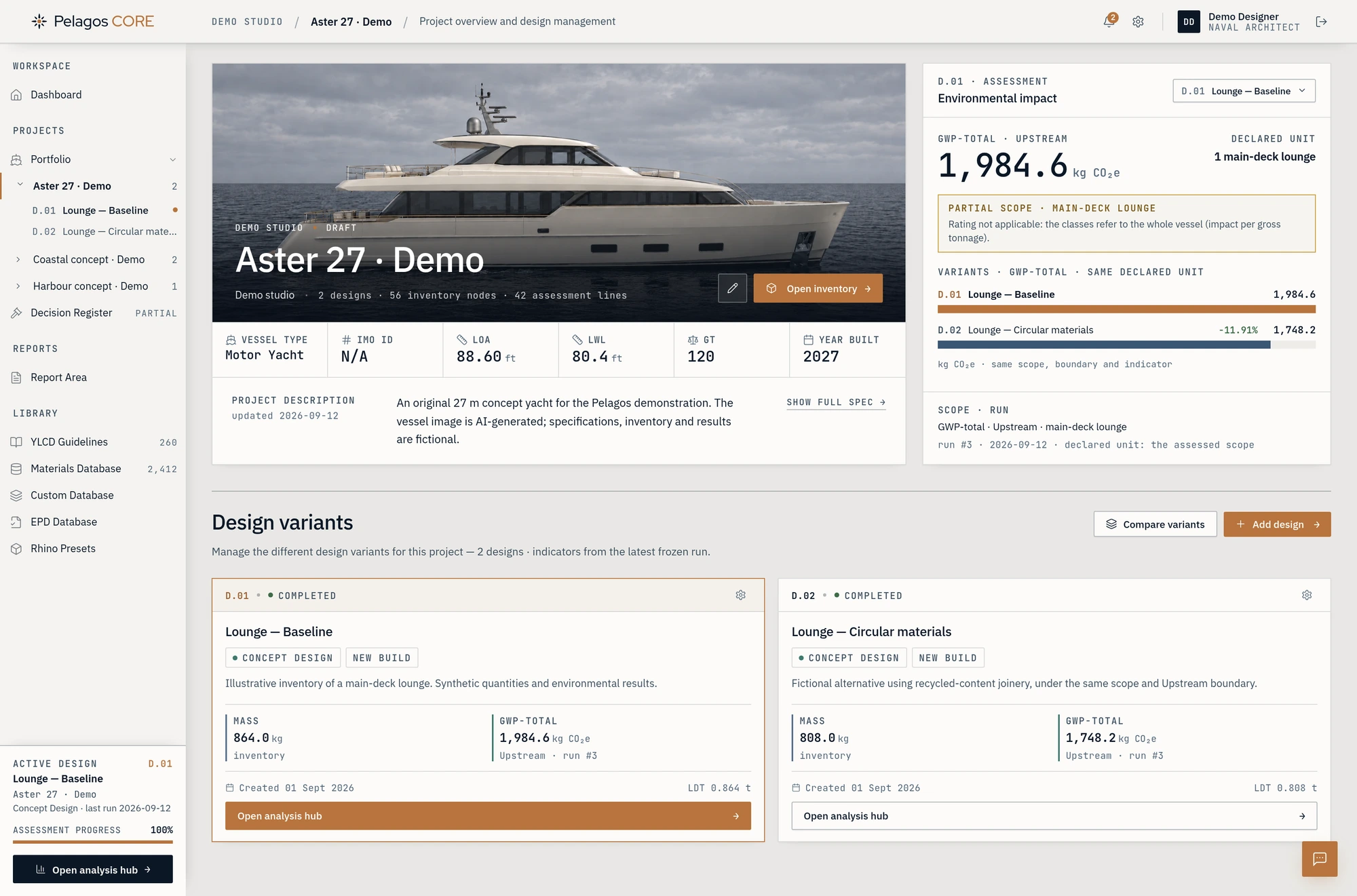
The operational core of Pelagos Core: Project and Design management, inventory, material matching, streamlined assessment, results and guidelines. Core screens use a fictional demo project with illustrative data and an AI-generated yacht image.
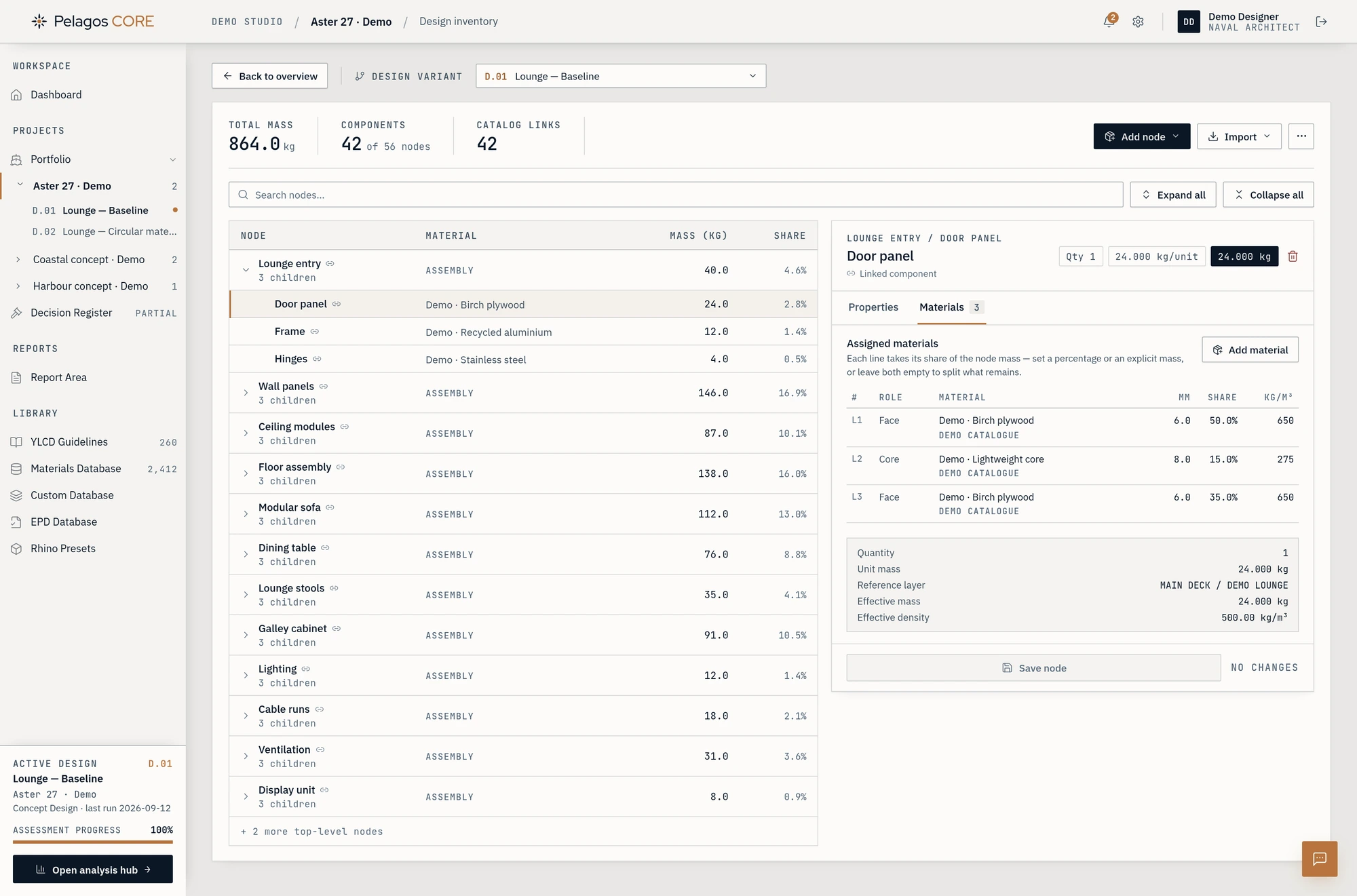
The Design BOM organises assemblies, systems, components and materials, each with quantity, mass and taxonomy. Data comes from Pelagos BOM, from imported documents and BOMs, or is entered by hand.
The calculation follows the four phases of ISO 14040/44 and takes PCR 2015:06 – Yachts, Small Crafts, Other Vessels and Components Thereof as its sector reference, while accepting the incomplete data of the early design stages and keeping it visible.
Contribution of an inventory item: activity quantity times the impact per unit, for each indicator.
Each transport stage: mass, distance and the factor of the transport mode.
Below 500 GT, per tonne in light craft condition and per year of the 30-year RSL; GT above.
The implemented calculation covers Upstream processes: materials, parts and components entering the vessel, with their transport. Construction (Core) and Downstream stages are outside it, and the boundary is recorded with every result. Pelagos produces a streamlined assessment for design support, not an EPD; its structure sets the path towards a Design-stage EPD.
A plug-in for Rhinoceros, where much of a yacht’s geometry is made. The BOM is built alongside the model, not derived at the end: elements can start as a quantity or an estimate and gain geometry as the project matures.
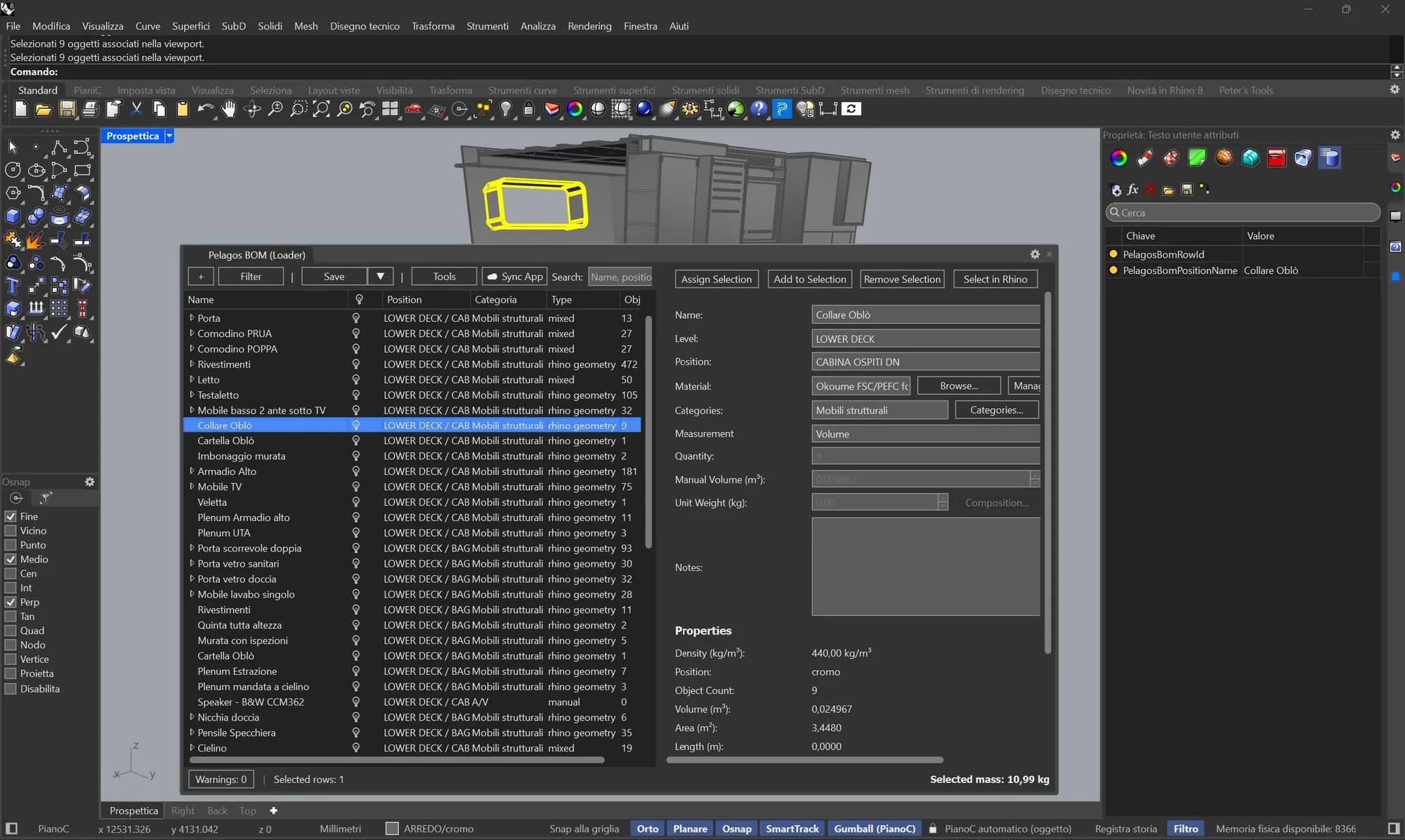
Rhino objects linked to BOM nodes. Links follow deletions, duplications and reassignments as the model evolves.
Volume, area, length and object count derived from geometry; manual values where the model is not there yet.
Presets synchronised with the Core library carry density and properties for mass calculation.
Multilayer panels and sandwich structures, mixed-mass purchased equipment, profiles by length.
Missing materials, insufficient quantities, invalid masses and broken object links are flagged.
Centre of gravity, surface weight and weight distribution, to see the trade-offs of lighter choices. Experimental.
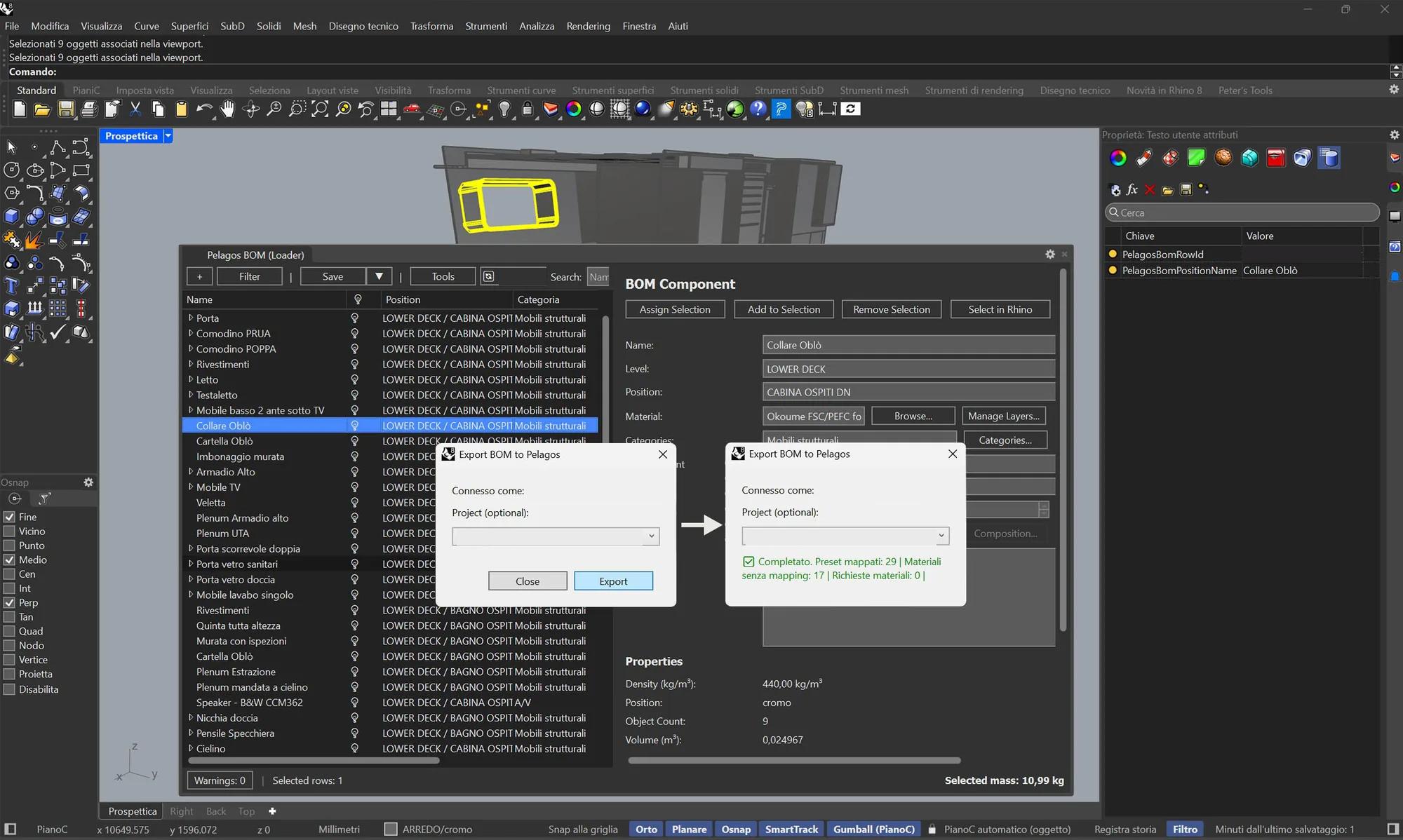
The structured inventory, with hierarchy, quantities, materials, masses and classifications, is exported to a Pelagos Core project. There each material is mapped to its environmental dataset. The same inventory can also be exported to external formats for checking.
Pelagos is a research prototype. Development went first to the workflow that makes the platform usable end to end, from project data to environmental results and guidance. This is where each part stands.
Available in the prototype and usable in its workflow.
A defined set of functions is operational.
Role and data structure defined, next in line.
Pelagos was developed within an Industrial PhD at the Department of Design of Politecnico di Milano, exploring how connected inventory, environmental assessment and design guidance can support yacht development.
πέλαγοςpélagos, “open sea” in Greek, and the name of the Pelagos Sanctuary for Mediterranean marine mammals: the maritime domain of the platform and its environmental orientation.
Process integration: when the supports are used, with which inputs and for which decisions.
Knowledge: 260 guidelines that contextualise Life Cycle Design for the yacht.
Digital decision support: data, inventory, assessment and comparison in one place.
A walkthrough on a yacht you are developing: from the Rhino model and the inventory to the first streamlined assessment and the guidelines that apply to its hotspots.


